

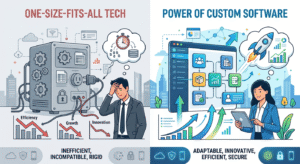
Every growing company reaches a point where its technology starts to feel like a bottleneck rather than a launchpad.
In the early stages, off-the-shelf software (Commercial Off-The-Shelf, or COTS) feels like a no-brainer. It is quick to purchase, simple to set up, and offers a low initial price point. However, as your operations expand and market demands evolve, standard solutions often turn into a messy ecosystem of workarounds, disconnected SaaS tools, manual spreadsheets, and recurring subscription fees.
If your team spends half its day adapting its workflows to match what your software allows, one-size-fits-all tech is actively holding your business back.
Here is why custom software development is becoming the definitive engine for sustainable business growth, operational speed, and long-term value.
1. Software Should Fit Your Workflows—Not the Other Way Around
Off-the-shelf applications are built for the average user across a broad industry. Because they cater to everyone, they rarely fit any single company perfectly. Teams often find themselves using only 30% of a tool’s feature bloat while relying on external spreadsheets or third-party add-ons to handle the remaining 70% of their actual work.
Custom software flips this dynamic. Engineered from the ground up to match your exact business logic, bespoke tools eliminate unnecessary steps, streamline task handoffs, and automate repetitive tasks.
Impact: Companies that replace fragmented, generic systems with tailored workflows routinely report operational efficiency gains of up to 30%, letting employees focus on high-value tasks rather than system navigation.
2. Owning vs. Renting: The True ROI of Bespoke Tech
Standard SaaS models appear cost-effective upfront, but they carry hidden financial friction:
-
Per-Seat Scaling Costs: Adding team members leads to escalating monthly licensing fees.
-
Feature Paywalls: Crucial enterprise capabilities are often locked behind high-tier subscription plans.
-
Vendor Lock-In: You are tied to the vendor’s price hikes, update schedules, and product sunsetting decisions.
Developing custom software requires a higher initial investment, but it converts software from an operational expense (OpEx) into a valuable corporate asset (CapEx). You own 100% of the source code and intellectual property (IP). As your user count grows, your licensing cost stays flat—delivering significant long-term ROI.
3. Creating a Truly Unfair Competitive Advantage
If you rely on the exact same software suite as your direct rivals, achieving operational differentiation becomes a steep climb.
Custom applications allow you to build proprietary functionality that competitors simply cannot purchase off the shelf. Whether it’s an AI-driven predictive pricing engine, a frictionless client portal, or an automated supply chain dashboard, bespoke tech enables you to deliver services faster, cheaper, and with higher precision than competitors bound by standard tools.
4. Modernizing Integration and Scaling
Fragmented systems create data silos. When your CRM, inventory database, and accounting tools don’t talk to each other cleanly, manual data entry increases, as does the risk of human error.
Custom solutions are architected around your existing digital infrastructure using API-first and modular microservices designs. This ensures every system communicates in real time, giving leadership a single, accurate view of business performance. As your transaction volume or user base expands, cloud-native custom software scales smoothly on your terms without requiring complete platform migration.
Off-the-Shelf vs. Custom Software: At a Glance
| Factor | Off-the-Shelf (COTS / SaaS) | Custom Software Solutions |
| Upfront Cost | Low initial cost | Higher upfront investment |
| Long-Term Cost | Compounds with user/tier growth | High ROI over time with zero seat fees |
| IP & Ownership | Vendor owned | 100% Client-owned IP |
| Fit & Flexibility | Generic (~30–50% fit) | 100% tailored to your business logic |
| Security | High-target target for mass exploits | Targeted security & industry compliance |
Is It Time to Make the Switch?
Standard software isn’t inherently bad—it serves a crucial purpose for basic functions like general email or accounting. However, when it comes to the core operations that define your unique value proposition, settling for generic tools puts a ceiling on your growth.
Investing in custom software isn’t just about writing code; it’s about engineering a flexible, secure digital ecosystem that grows with your business and sets you apart in a crowded marketplace.
#CustomSoftware #SoftwareDevelopment #DigitalTransformation #TechStrategy #BespokeSoftware #BusinessGrowth #EnterpriseTech #WorkflowAutomation #SoftwareEngineering #TechInnovation #BuildVsBuy #SaaS